The Invisible Work Is the Real Work: Why Your Process Deserves an Audience
There's a version of your creative life that the internet sees. The final product. The clean reveal. The thing you spent weeks on, compressed into a single shareable moment.
And then there's everything else. The false starts. The version you almost went with. The afternoon you spent staring at something that wasn't working and couldn't figure out why. The weird ritual you do before you sit down to create. The decision you made that you're still not sure about.
That second category—the invisible work—is where most of the actual creating happens. And almost nobody shows it.
That's worth paying attention to.
Why We Default to the Finished Version
The impulse makes total sense. You want to put your best foot forward. You've worked hard on something, and you want people to see the result of that work, not the stumbling around that preceded it.
There's also a vulnerability thing happening. Sharing finished work feels risky enough. Sharing the messy middle—where you don't know what you're doing yet, where the doubts are loudest—feels almost reckless.
So we curate. We wait until it's done. We present the polished artifact and let the process disappear.
But here's what gets lost in that approach: the process is often the most interesting part. Not just for your audience—for you, too.
What Process Sharing Actually Does
Let's talk about what happens when creators start pulling back the curtain.
First, the obvious thing: it builds connection. There's a reason behind-the-scenes content consistently outperforms finished-product reveals across almost every platform and medium. People don't just want to see what you made—they want to understand how you think. They want the human story underneath the artifact.
When someone watches you wrestle with a decision in real time, or sees the sketch that became the finished piece, or hears you talk through why you scrapped the first three versions—they become invested. Not just in the work, but in you. That's a fundamentally different and more durable kind of connection than admiration from a distance.
Second, and this one gets overlooked: sharing your process makes you a more interesting creative presence over time. Finished work is, by definition, static. It's done. But process is ongoing—it's always generating new material, new questions, new moments worth sharing. The creator who only shares finished work runs dry. The creator who shares the journey always has something to say.
Third—and this is the one I've personally felt most—documenting your process forces you to be more intentional about it. When you know you're going to articulate a decision, you actually make the decision consciously instead of just stumbling into it. The act of sharing teaches you about yourself as a maker.
What "Process" Actually Means (It's Broader Than You Think)
When people hear "share your process," they often picture time-lapse videos of paintings or before-and-after shots. And sure, that's part of it. But process is a much bigger category than that.
Process is the question you're currently stuck on. It's the reference images you've been obsessing over. It's the tool you just switched to and why. It's the creative ritual that helps you get started—the specific playlist, the particular time of day, the weird superstition you've stopped apologizing for.
Process is the failure that redirected you. The version that didn't work and what it taught you. The decision you made that surprised even you.
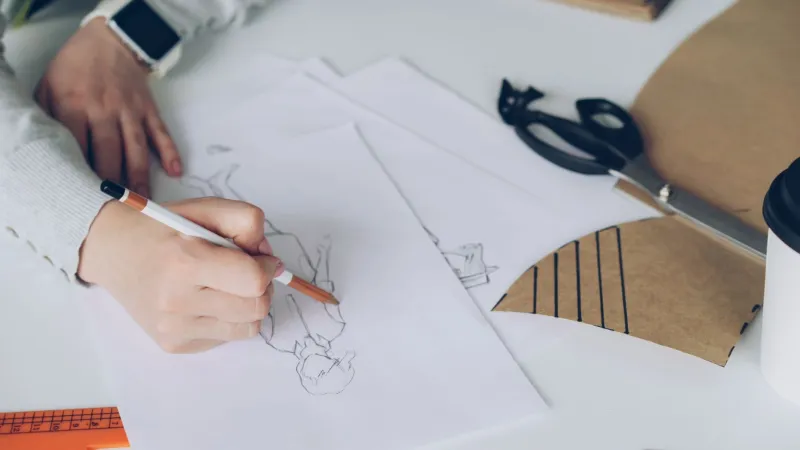
Process is also the thinking that happens before you make anything. The research rabbit hole. The conversation that sparked the idea. The sketch on a napkin that became the thing.
All of that is shareable. All of it is genuinely interesting to people who care about making things—and that's a much wider audience than you might think.
Making It Practical: How to Start Sharing What You Usually Hide
You don't have to overhaul your whole approach to content. Start small and specific.
Pick one decision per project and explain it. Not defensively—just openly. I went with this color palette because I wanted the mood to feel like late afternoon in the summer. Here's what I tried first. That's a window into your creative mind that a finished image alone never provides.
Document the experiments that don't work. This one takes some nerve, but it pays off. When something fails—when you try a direction and it falls apart—share that. Not as self-deprecation, but as genuine creative inquiry. This didn't work and here's what I think I learned. That kind of transparency is rare, which means it stands out.
Talk about your rituals without embarrassment. The weird stuff you do to get in the creative headspace. The coffee shop you have to go to. The specific kind of notebook. The album you put on repeat. These details humanize you in a way that polished work can't. They make you real.
Share the question before you have the answer. Most creators wait until they've figured something out before they say anything about it. Try flipping that. I'm currently trying to figure out X. Here's where I'm at. Inviting people into the uncertainty is more compelling than delivering certainty after the fact.
Your Process Is Your Competitive Advantage
Here's the thing about a finished product: someone else can make something that looks similar. Style can be approximated. Outputs can be replicated.
But your process? The specific way you think through problems, the particular combination of influences you're drawing from, the decisions only you would make for the reasons only you have—that's irreducible. That's genuinely yours.
And right now, most creators are keeping that part locked away, treating it like a liability or a distraction from the "real" work.
Flip that script. The invisible work is the real work. The process is the story. And sharing it—consistently, honestly, without waiting until it's perfect—is one of the most powerful things you can do for your creative career.
The finished piece gets a moment. The process gets a relationship. And a relationship is worth a lot more in the long run.