Your Old Work Isn’t a Graveyard. It’s a Quarry.
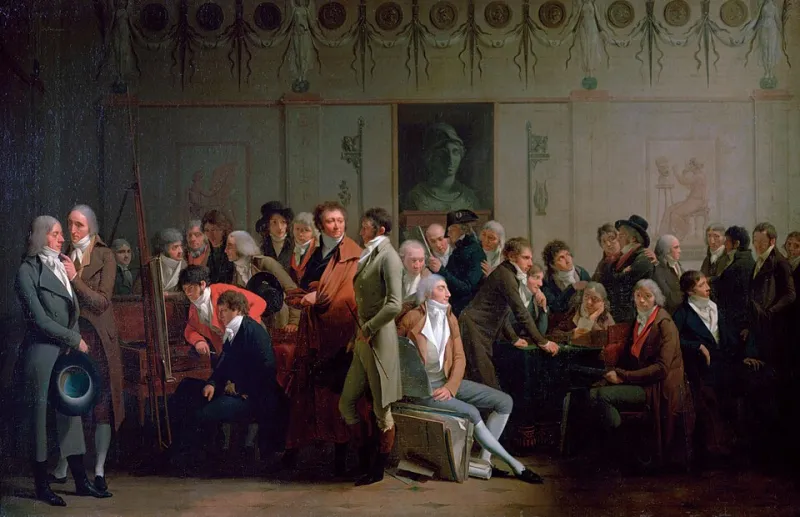
Photo: Louis-Léopold Boilly, Public domain, via Wikimedia Commons
Most artists I know have a folder they avoid. Mine is called _old_stuff_final_FINAL, and it lives on an external drive that hums like a tiny refrigerator. For years I treated that folder like a crime scene: evidence of every bad draft, every abandoned series, every idea that did not survive contact with a deadline.
Then I started teaching a workshop on revision, and I realized something embarrassing. The work I was most proud of did not come from a lightning bolt. It came from old material that I finally knew how to use. The archive was not a graveyard. It was a quarry.
Stop treating your archive like a confession
A lot of us avoid old work because we think it will remind us how bad we used to be. Mine does. Great. That is not a reason to stay away. It is a reason to look with a different job description. You are not there to judge the past version of you. You are there to mine. A quarry does not care whether the rock is pretty. It cares whether the rock can be cut.
So before you open the folder, make one rule: no nostalgia tours. You are not scrolling to feel something. You are scrolling to find material. Set a timer. Twenty minutes. Take notes. Close the folder. That is the whole emotional regulation plan.
The quarry method, step by step
I use four steps, and I keep them boring on purpose.
1. Make a mess map. List every project in the archive, even the ones you hate. Do not evaluate yet. Just name them. For each one, write one line: what was it trying to do? Not what it was. What it was trying to do. That gap is where the useful material hides.
2. Name the obsession. Look for the same image, question, color, argument, or character showing up in three different projects. Do not call it a theme. Themes are for grant applications. Obsessions are for making work. If you keep drawing empty chairs, or writing about people leaving voicemails, or photographing motel curtains, that is not a phase. That is a signal.
3. Extract one usable part. This is where most people get stuck. They try to revive the whole abandoned project. Do not do that. Take one piece: a color palette, a sentence, a structure, a title, a character, a chord change, a way of cropping a photo. The piece does not have to be good. It has to be portable.
4. Set a constraint and rebuild. Now make something new with that piece. The constraint can be anything: one page, one color, one take, one material, one afternoon. The point is to keep the old work from dragging its original failure into the new room. You want the residue, not the corpse.
What to do when nostalgia shows up
Nostalgia is not the enemy, but it is a bad project manager. It will tell you to remaster everything, to relaunch the old series, to finally finish the thing you abandoned for a reason. That is not mining. That is a reunion tour.
When I feel nostalgic, I write down the feeling and keep moving. If the feeling is strong enough, I make a note for a future piece. But I do not let it change the assignment. The assignment is to find raw material, not to redeem the past.
The archive is a studio, not a museum
A museum preserves work. A studio uses it. That distinction matters. Your old work is not a permanent record of your limitations. It is a stockpile of decisions you already made, instincts you already had, and problems you already started solving.
So open the folder. Set the timer. Look for the obsession, not the verdict. Take one piece. Make one new thing. The past is not a place you have to apologize for. It is a place you can borrow from.