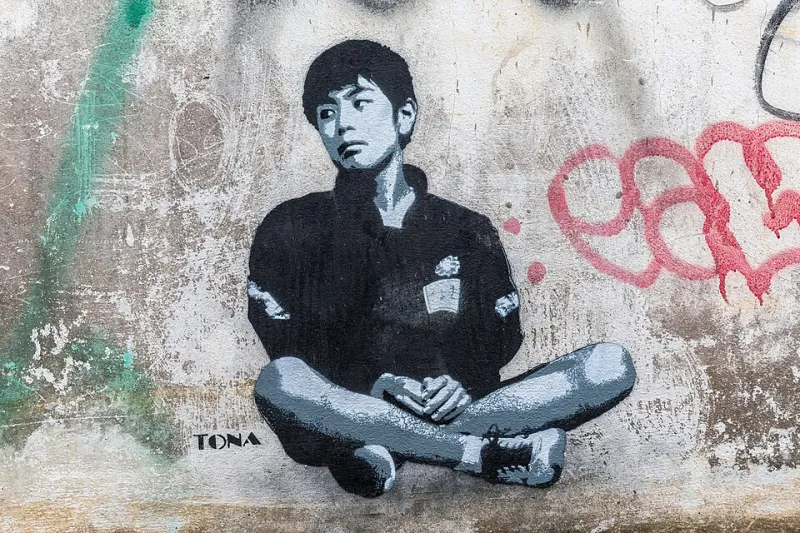
Someone Else's Highlight Reel Is Not Your Report Card

Photo by Photo by Sinitta Leunen on Unsplash on Unsplash
Let me set a scene you've probably lived.
It's late. You're sitting with a half-finished project — maybe a draft, a design, a recording — and instead of working on it, you've drifted over to someone else's Instagram or portfolio site. You start scrolling. Their work is clean. Their bio reads like a press kit. They've got a residency, a collab with someone you admire, and what appears to be an effortlessly assembled body of work that makes yours feel like a pile of sticky notes on a coffee-stained desk.
You close the tab. You don't go back to your project. You just kind of... sit there.
I've been there more times than I want to count. And what I eventually figured out — the hard way, naturally — is that what I was doing in those moments had almost nothing to do with that other creator. It was about me, and a very specific trick my brain was playing on me.
The Curated Lie We All Agree to Believe
Here's the thing nobody says out loud enough: what you see on someone's portfolio or social feed is an edited retrospective. It is, almost by definition, not the truth of how their creative life actually unfolded.
You're seeing the work they chose to show. The pieces that landed. The collaborations that actually went somewhere. You are not seeing the two years of mediocre output before they hit their stride. You're not seeing the project they quietly deleted, the pitch that bombed, the season where they questioned everything and almost quit.
When you scroll through someone's feed and try to reverse-engineer a timeline — "they started in 2019, got their first big feature in 2021, now look at them" — you are building a story out of monuments while ignoring all the rubble. And then you're holding your rubble up next to their monuments and wondering why you feel terrible.
That's not comparison. That's self-sabotage with extra steps.
Why Our Brains Are Wired to Do This
Comparison isn't a character flaw. It's actually a pretty old piece of human software — we're wired to measure ourselves against others as a way of orienting ourselves socially. The problem is that software was written for small communities where you could see the full picture of someone's life, not for an internet that lets you access the polished output of thousands of creators at any hour of the day.
Psychologists call it "social comparison theory," and the short version is this: we use other people as reference points to evaluate ourselves. When we compare upward — to people who seem further along — it can either motivate us or deflate us. And when we're already feeling uncertain about our work, deflation wins almost every time.
Social media turbocharges this by creating what researchers sometimes call "the highlight reel effect." Everyone's profile is a best-of compilation. Nobody posts their rejected pitches or their abandoned drafts. So the reference points we're using to evaluate ourselves are systematically skewed toward success. We're comparing our blooper reel to everyone else's trailer.
Measuring Progress Without a Ruler Borrowed from Someone Else
So what do you actually do with this? You can't just decide to stop caring. That's not how brains work. But you can redirect the energy.
The most useful shift I've made is moving from external benchmarks to internal ones. Instead of asking "where am I compared to them," I started asking "where am I compared to where I was six months ago?"
This sounds simple. It is not always easy, especially when six months ago you were also struggling and the comparison still stings. But it forces you to engage with your actual trajectory instead of someone else's.
A few things that have genuinely helped me:
Keep a running log of your own work. Not a portfolio — a log. Every draft, every attempt, every finished and unfinished thing. Date it. When you go back through it, you will almost always be surprised by how much ground you've actually covered. We tend to forget our own progress in real time.
Set process goals instead of outcome goals. "I want to get featured in X publication" is an outcome goal — it depends on factors you don't fully control. "I want to write three pieces this month that push my craft in a new direction" is a process goal. You can actually measure that. And hitting it feels like real evidence of movement, not a lottery ticket.
Give yourself a 90-day window. Most creative progress is invisible at the day-to-day level. Pull back to a quarterly view and you'll often see things you couldn't see up close.
Using Other People's Work Without Letting It Use You
Here's what I'm not saying: stop looking at other creators' work. That would be absurd. Other people's creative output is one of the richest sources of inspiration and education available to you. The goal isn't to stop looking — it's to change why you're looking.
When I open someone's portfolio now, I try to come in with a specific question. What's the structure here? How did they handle this particular problem? What choices did they make about pacing, voice, format, framing? I'm treating it like a case study, not a report card.
That mental shift changes everything. You go from "why don't I have this" to "what can I learn from this." One of those feels like punishment. The other one actually makes you better.
It also helps to remember that the creators you admire most were once exactly where you are. Not metaphorically — literally. They had the unfinished projects and the uncertain direction and the nagging feeling that everyone else had figured something out they hadn't. The only difference between then and now is time and repetition. That's it. That's the whole secret.
The Only Timeline That's Actually Yours
I'll be straight with you: there's no version of a creative life that doesn't involve some amount of comparison. It's going to happen. What you can control is what you do with it when it shows up.
You can let it sit on your chest at midnight and convince you that you're behind, that you've wasted time, that the window is closing. Or you can notice it, acknowledge it for the distortion it is, and turn back to your own work.
Your timeline is not late. It's not slow. It's just yours — and it's still being written. The person you're comparing yourself to right now? They're probably looking at someone else's feed doing the exact same thing.
Close the tab. Go make something.